Blade Runner 2049 - Tyrell Archive Room


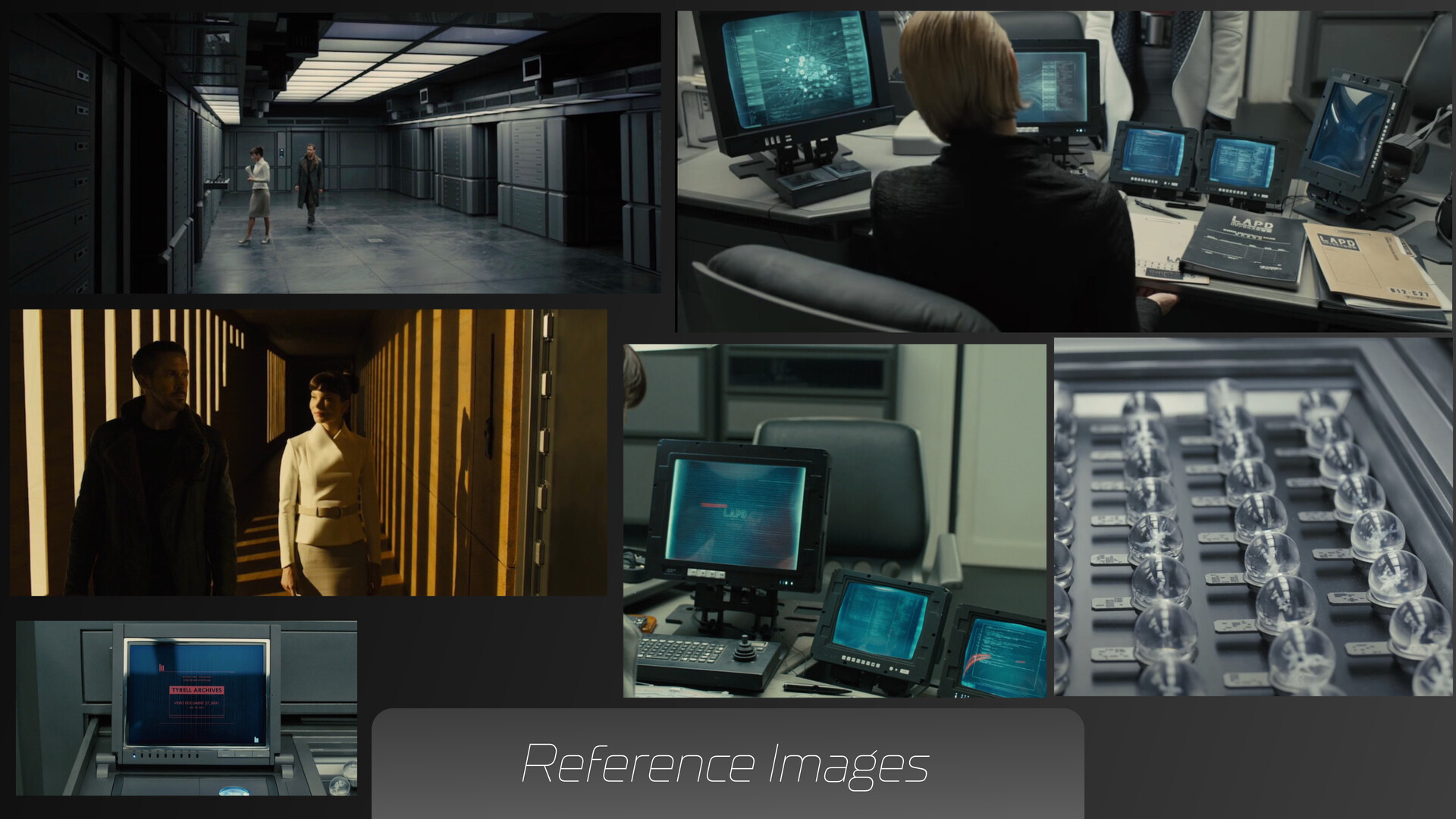


Blade Runner 2049 featured an impressive wide range of structural design and lighting. Within the Wallace Corporation lies the Tyrell Archive where K tries to discover more information throughout the film. The archive room features and large open room of archive storage machines holding fragments of pre-blackout data.
For modeling, I decided to use the weight-faced normals technique rather than baking lots of assets due to the majority of geometry being hard surfaces. This technique is magical and works well with almost any hard surface/straight edge surface. I love how this approach allows for high levels of detail with very little geometry. The archive set also allowed me to approach the scene from a modular aspect rather than everything being uniquely modeled.
After analyzing and planning how I wanted to approach the scene, I decided to add two extra modules, a power module for the storage machines and a full computer system and desk for an added layer of storytelling. I conceptualized and modeled my power module that would provide power to the storage modules. I added piping alongside the edges of the power module for additional cooling.
In Blade Runner 2049 the surfaces are quite shiny and clean, but I felt an archive that hasn’t been used or visited in decades should have at least a layer or two of rust on it. Luv says “This room hasn’t been visited in years.”.
I started my texturing process in Substance Designer, creating a maximum of 3 tillable textures that I can use to texture all modular assets and use for unique asset texturing. I created the trim sheet only for the perimeter assets such as the vents, railings, upper walls, and ceiling. The trim sheet helped with texturing smaller modular objects, especially with the unlimited space you have within the UV layout to allow the trim sheet to work for you.
The remaining assets such as the power module, storage machine, and desk assets were all uniquely textured within Substance Painter. For the power module and storage machine, I simply made 2 variations of the assets within Painter and duplicated them within my unreal scene to save memory and optimize my draw calls.
I lit and rendered all shots using lumen and had a blast trying to make the lighting work. When lighting a cold dark room, lighting becomes an empty canvas. I like Unreal Engine's post process features allowing for minimal grading in posts.
I am happy with the final result. This project was mostly about upgrading my skills and focusing on creating polished portfolio projects.